
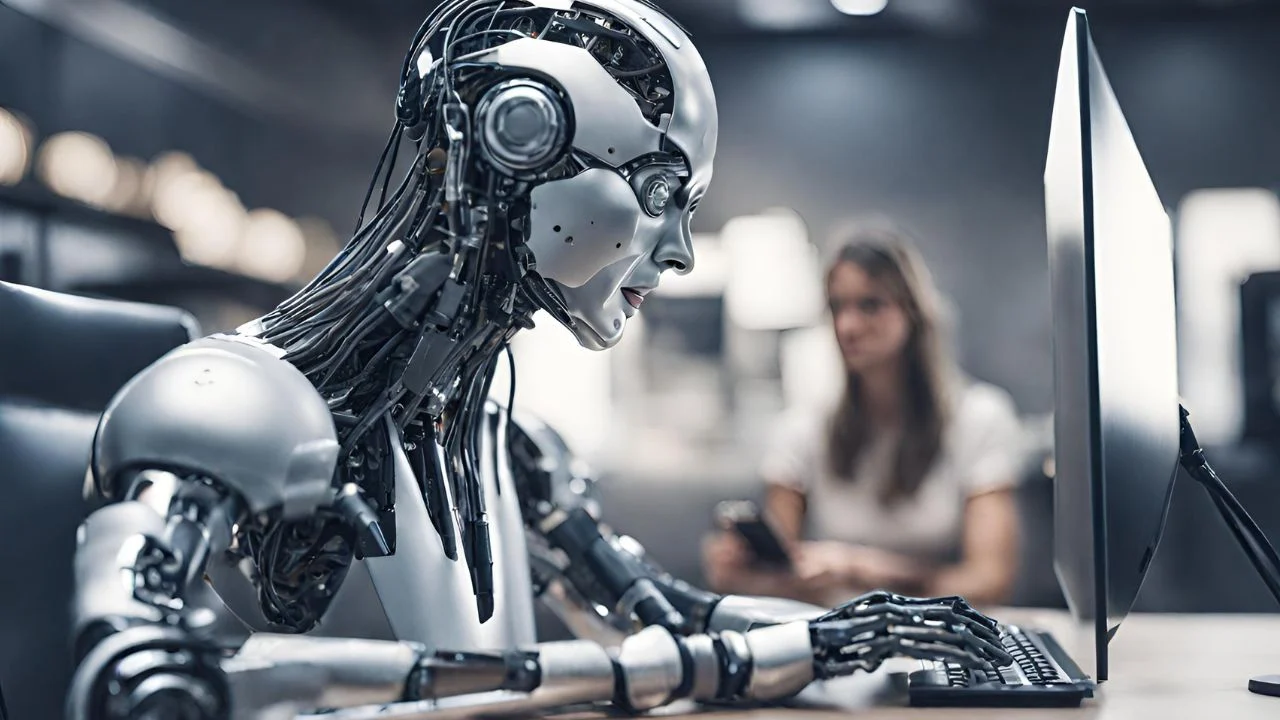
Artificial Intelligence has become one of the most disruptive forces in software development history. With tools like GitHub Copilot, Cursor, and autonomous coding agents capable of generating entire applications, a pressing question dominates developer communities:
Is AI replacing software developers?
The short answer: No but it is radically redefining the profession.
Rather than eliminating developers wholesale, AI is transforming how software is built, shifting responsibilities, automating repetitive work, and raising the bar for what it means to be a “skilled” engineer. This shift is already reshaping hiring, career paths, and daily workflows across the industry.
AI as an Augmentation Tool, Not a Replacement
Despite alarming headlines, AI is not functioning as a full replacement for human software engineers. Instead, it acts as a powerful augmentation layer.
AI tools such as GitHub Copilot, Amazon Q Developer, and Cursor assist developers by:
- Writing boilerplate code
- Generating tests
- Suggesting refactors
- Explaining unfamiliar code
- Speeding up repetitive tasks
This augmentation allows developers to move faster and focus on more valuable work. As Conner Ardman explains in his 2025 video “Is AI Actually Replacing Software Engineers?”, AI is best understood as a productivity multiplier rather than a job destroyer.
In practice, this means a single developer can now do the work that once required several people not because the developer is replaced, but because AI handles the mundane parts of the job.
A Major Shift in Developer Focus
One of the most significant changes AI brings is where developers spend their time.
Before AI:
- Writing boilerplate logic
- Manually debugging syntax errors
- Searching documentation
- Implementing repetitive patterns
After AI:
- Designing system architecture
- Solving higher-level business problems
- Reviewing and validating AI-generated code
- Debugging logic rather than syntax
- Translating vague requirements into precise technical systems
This shift places greater importance on thinking skills over typing skills.
As many experienced engineers note, the hardest part of software development has never been writing code it’s understanding requirements, handling edge cases, designing scalable systems, and making trade-offs. AI does not remove this complexity; it amplifies the need for it.
Redefining the Role of the Software Engineer
AI is also redefining job roles within the profession.
The Rise of “AI-Capable” Engineers
Modern developers are now expected to:
- Effectively prompt AI tools
- Verify AI-generated output
- Detect hallucinations or flawed logic
- Ensure security, performance, and maintainability
- Integrate AI into workflows responsibly
This creates demand for engineers who can manage AI, not blindly trust it.
According to discussions echoed by Carnegie Mellon University and TalentSmart, the future of software engineering lies in human–AI collaboration, where humans provide:
- Strategic oversight
- Creativity and design thinking
- Ethical judgment
- Contextual understanding
- Quality control
AI may write code, but humans decide what should be built and why.
Why Entry-Level Developers Are Most Impacted
The most visible disruption is happening at the entry-level.
AI excels at:
- Simple CRUD operations
- Straightforward scripts
- Common patterns
- Copy-paste style coding
These tasks were traditionally how junior developers gained experience. As a result:
- Fewer entry-level roles are available
- New graduates face tougher competition
- Employers expect stronger fundamentals earlier
This concern is highlighted in multiple discussions, including ForrestKnight’s video “Software Engineers are WRONG about AI taking our jobs”, where he argues that AI exposes weak fundamentals rather than eliminating real engineering work.
For junior developers, survival now depends on:
- Strong computer science fundamentals
- Understanding system design earlier
- Learning how to validate and improve AI output
- Demonstrating problem-solving skills beyond syntax
Experienced Developers: Faster, but Not Immune
Senior and experienced developers benefit greatly from AI but they are not unaffected.
Benefits:
- Increased productivity
- Faster prototyping
- Reduced cognitive load
- Easier exploration of new technologies
Challenges:
- Constantly evolving tools
- Higher expectations from employers
- Fewer roles due to efficiency gains
- Need to adapt workflows quickly
Recent job market data and media coverage including a December 2025 Los Angeles Times article titled “They Graduated from Stanford. Due to AI, They Can’t Find a Job” reveal that even experienced engineers face hiring slowdowns as companies leverage AI to reduce team sizes.
The issue is not skill it’s market recalibration.
Is AI Eliminating Software Jobs? Or Changing Them?
While some traditional roles are shrinking, new ones are emerging:
- AI systems engineers
- AI integration specialists
- Prompt engineers
- AI quality assurance engineers
- Human-in-the-loop reviewers
Rather than mass extinction, the profession is undergoing role compression and specialization.
As discussed in “Will AI Replace Programmers?” featuring ThePrimeagen and Lex Fridman, current AI lacks:
- True general intelligence
- Long-term reasoning
- Deep domain intuition
- Accountability
AI can assist but it cannot own outcomes.
Why AI Still Can’t Replace Human Engineers
Despite rapid progress, AI struggles with:
- Ambiguous requirements
- Novel system design
- Long-term maintenance decisions
- Ethical and legal considerations
- Understanding human intent
As noted in Quora discussions and academic commentary, software engineering is as much about communication and judgment as it is about code. These human traits remain irreplaceable.
AI is powerful but it does not understand consequences.
The Future: Human–AI Collaboration
The most realistic future is not AI vs. developers it’s AI with developers.
Successful engineers will:
- Treat AI as a junior assistant, not an authority
- Validate everything AI produces
- Focus on creativity, architecture, and impact
- Continuously upskill as tools evolve
As Carnegie Mellon University research emphasizes, collaboration between humans and AI consistently outperforms either alone.
Final Thoughts
AI is not killing software development it is forcing it to grow up.
The era of copy-paste coding is fading. In its place is a profession that values:
- Critical thinking
- Systems understanding
- Creativity
- Accountability
- Ethical oversight
For developers willing to adapt, AI represents the greatest productivity boost in history. For those unwilling to evolve, it exposes limitations that were once hidden.
Software engineering is not disappearing it is being redefined.